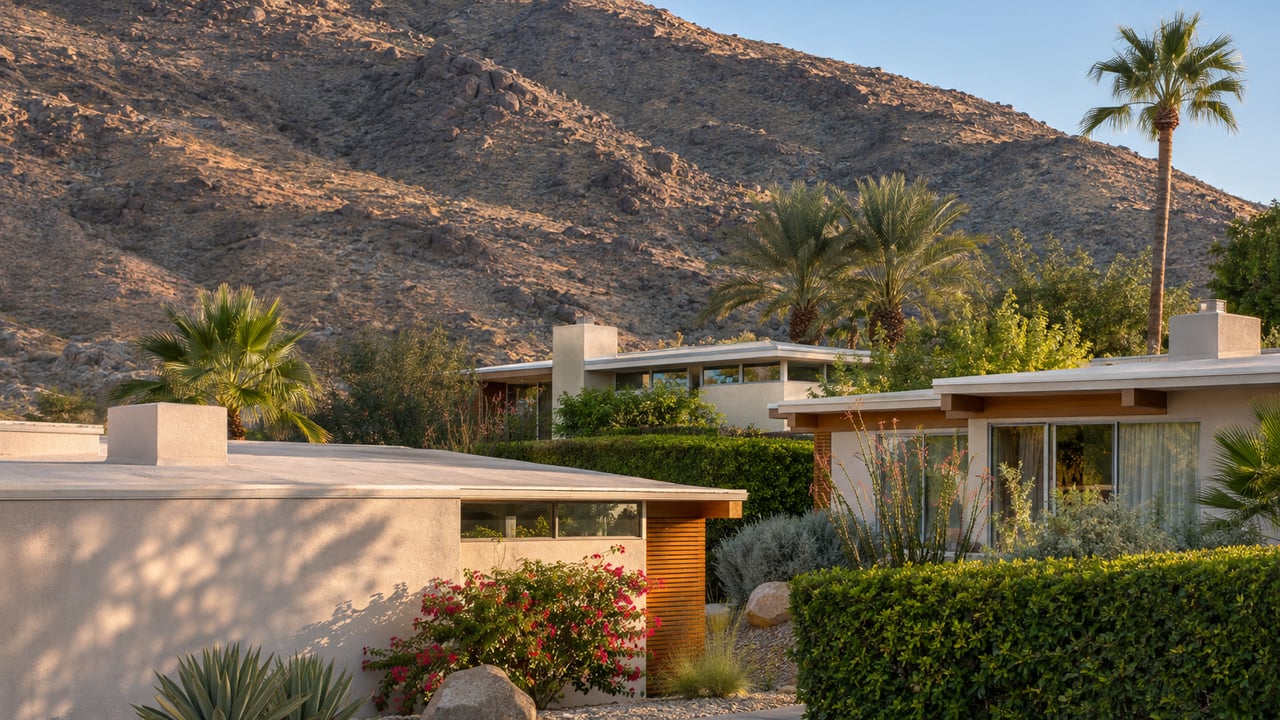
Where Palm Springs Home Prices Sit Against Their 2022 Peak
November 19, 2026
November 19, 2026
In November 2022, the Palm Springs City Council voted to limit vacation rentals by neighborhood. The vote was aimed most directly at places like Racquet Club Estates, where rentals had grown to almost 40% of homes, according to The Palm Springs Post. Four years later, the city's vacation rental table dated November 12, 2026 shows Racquet Club Estates with 170 registered rentals across 537 homes. That is 31.66%, still the highest share of any organized neighborhood in the city, and 35 more owners are on its waitlist.
That neighborhood is one place to start reading the number buyers keep running into this season. The Greater Palm Springs Realtors October 2026 Desert Housing Report puts the average-size Palm Springs detached home 23.3% below its 2022 high. That is the largest drop of any city in the Coachella Valley. Over the past year, though, Palm Springs prices have barely moved. The gap measures how far some 2022 purchase prices ran past what the market would pay once rental income, low rates and pandemic demand stopped lining up. For a buyer, the room to negotiate sits in the listings still priced against that peak, and less so in the city as a whole.
The GPSR October 2026 report estimates a 2,175-square-foot Palm Springs detached home at $1,087,500, based on a three-month median of $500 per square foot. That is down 0.2% from a year earlier and down from a 2022 high of $1,417,969. This is a modeled benchmark, not a median of closed sales. GPS Business Insider describes the method as each city's median price per square foot multiplied by a fixed typical home size. The method holds home size constant, which makes the cities easier to compare.
Here is how the main cities compare in the October 2026 report:
| City | Avg.-size detached home, Oct. 2026 | 12-month change | Below 2022 high |
|---|---|---|---|
| Indian Wells | $1,906,800 | +7.1% | 6.6% |
| Rancho Mirage | $1,354,865 | +0.8% | 7.4% |
| La Quinta | $824,458 | +3.8% | 9.6% |
| Cathedral City | $549,200 | -3.0% | 10.8% |
| Palm Desert | $661,584 | -7.4% | 18.0% |
| Palm Springs | $1,087,500 | -0.2% | 23.3% |
The two right-hand columns tell different stories. Palm Desert is still falling, down 7.4% in a year. Palm Springs has the largest gap from its peak but has been close to flat for twelve months. Its decline happened earlier and has stopped. A buyer comparing Palm Springs with Palm Desert or Indian Wells is looking at three different points in the same cycle.
Condos took a smaller hit. The same report puts the 1,250-square-foot Palm Springs attached home at $411,453. That is 0.7% lower than a year ago and 14.3% below its 2022 high of $480,000. In Palm Springs, detached homes have given back more of the boom than attached homes.
The peak in Palm Springs had more holding it up than in other valley cities. The Palm Springs Post reported that single-family prices in the neighborhoods the 2022 vote targeted rose about 9% from 2019 to 2020, 35% from 2020 to 2021 and 33% from 2021 to 2022. Prices then fell about 14% from 2022 to 2023. A three-year run of that size goes beyond what full-time demand normally produces. In those neighborhoods, many purchases were priced partly on expected rental income.
In the same Post story, agent David Carden described sellers who had bought at the top. "Sellers who bought at the height of the market, when housing prices were going up 10%, 20% a year, are still trying to make a tidy profit," he said. "And the market does not support that, it's not sustainable." The Post put the correction in a national context too. Interest rates were rising, and pandemic-era "Zoom towns," Palm Springs among them, were expected to see the sharpest corrections.
Palm Springs was also more exposed to that kind of buyer from the start. Palm Springs Life counts about 30.3% of the city's housing units as vacant, compared with 19.5% in Cathedral City. That reflects a seasonal, second-home market. When much of a city's housing is owned as second homes, demand rises and falls with the choices of buyers who don't have to buy, and those buyers were the first to pull back as rates went up.
The rental market has since settled. The Post reported 2,927 permitted vacation rentals at the June 2024 peak and 2,777 in October 2025. The city's November 12, 2026 table lists 2,608 registered rentals citywide, 7.42% of residential units, with 98 owners on waitlists in all. The waitlists are in a small number of places. Racquet Club Estates has 35 waiting. Desert Park Estates is at 20% with 19 waiting, El Mirador at 19.75% with 12, Movie Colony East at 19.38% with 12, Sunmor at 25% with 11 and El Rancho Vista Estates at 21.43% with 6. Vista Las Palmas at 18.14%, Indian Canyons at 10.04% and Old Las Palmas at 9.62% have no one waiting.
The citywide 23.3% figure averages together neighborhoods that have moved in very different ways. The most recent full-year look by neighborhood is the 2025 table in Palm Springs Life's city guide. It estimates the change in an average-size home's value over 2025. These are last year's numbers, and several rest on fewer than ten sales.
For detached homes, 2025 was a down year in The Mesa at 31.4% on 15 sales and Racquet Club West at 27% on 9. Parc Andreas fell 22.6% on 3 sales, Sunrise Park 16.7% on 30, Sunmor 16.6% on 7 and El Mirador 15.8% on 4. Desert Park Estates fell 13.5% on 46 sales, Vista Las Palmas 10% on 18, the Movie Colony 8.8% on 8 and Old Las Palmas 2.5% on 16. In the same year, Twin Palms rose 24.6% on 9 sales, Indian Canyons 11.1% on 23, Tahquitz Creek Golf 8.3% on 18 and Warm Sands 7.6% on 14. Movie Colony East, a waitlisted neighborhood, rose 47.6% on just 7 sales.
Rental density alone doesn't predict which streets lost value. Sunmor, Desert Park Estates and El Mirador all have waitlists and all fell in 2025. Movie Colony East has a waitlist and rose sharply. Neighborhoods with 15 to 20 sales a year can swing double digits because of what happened to sell: one restored Alexander can outweigh three dated ranch houses. What the table does show is that "23% below peak" describes no single Palm Springs neighborhood. In some, last year's buyers paid more than the year before. In others, the 2022 price is still a long way off.
The condo side had its own small-sample swing this summer. The California Desert Association of Realtors August 2026 sheet showed the Palm Springs condo median at $385,000, down 14.3% from August 2025, on 51 sales. The three-month median, $385,000 against $414,750 a year earlier, moved much less. A single month of attached sales is too thin to tell you where condo values are heading.
The fall numbers show a market that has slowed down but isn't falling. In the three months ending September 2026, Palm Springs averaged 97 sales a month, down from 117 a year earlier, and led the valley in sales for that period. The median home sold in 55 days, faster than the 61 days a year earlier. Detached homes closed an average of 4.0% below list price, compared with 3.8% a year earlier. Inventory on October 1 equaled 6.2 months of sales, up from 5.2, The Palm Springs Post reported. By the end of October, the city had 703 homes listed, against 710 a year earlier. The GPSR October report puts Palm Springs at 88 sales, second to Palm Desert's 96 and ahead of Indio's 80.
Taken together, those numbers say Palm Springs isn't short of buyers. There are fewer of them, and they are pickier. Well-priced homes are selling faster than a year ago. The average discount to list is about 4%, a long way from 23%. A seller whose asking price still reflects a 2022 purchase is setting a price against the peak, and those listings are where a buyer has room. Homes that list at today's numbers usually close close to them.
Higher price points come with more room. Across Greater Palm Springs, homes listed at $2 million or more averaged 21 sales a month in the October report, down from 30 a year earlier. They sold at an average 5.4% below list price, GPS Business Insider reported. The same article notes that list-to-sale discounts leave out earlier price cuts and negotiated concessions, so the full savings on a given deal can be larger than the average shows.
Financing changes how much any discount is worth. Freddie Mac's November 5 survey put the average 30-year fixed rate at 7.18%, compared with 6.22% a year earlier. GPS Business Insider calculated that on a $488,000 loan, monthly principal and interest come to about $3,306 at 7.18% and about $2,995 at 6.22%, a difference of roughly $311 a month. These figures are general market information, not financial advice, so confirm your own numbers with your lender. Compared with a year ago, a financed buyer pays more each month on the same price, while a cash buyer pays the price and nothing more.
The October report covers closed sales only and has no pending-sales measure, so it can't predict how many winter visitors will turn into buyers. It does show where this season starts. Palm Springs is one of the valley's two busiest markets, its prices have held steady for a year, and the deepest discounts are on listings still priced against 2022.
If you're weighing a Palm Springs neighborhood against the rest of the valley, Scott James Properties can show you how close a specific address sits to its own peak and what similar homes have actually closed for this year. Start with our buyer services, or, if you bought near the top and are thinking about selling, request a home valuation based on current comparable sales. Schedule a Free Consultation.
Stay up to date on the latest real estate trends.
We pride ourselves in providing personalized solutions that bring our clients closer to their dream properties and enhance their long-term wealth. Contact us today to find out how we can be of assistance to you!