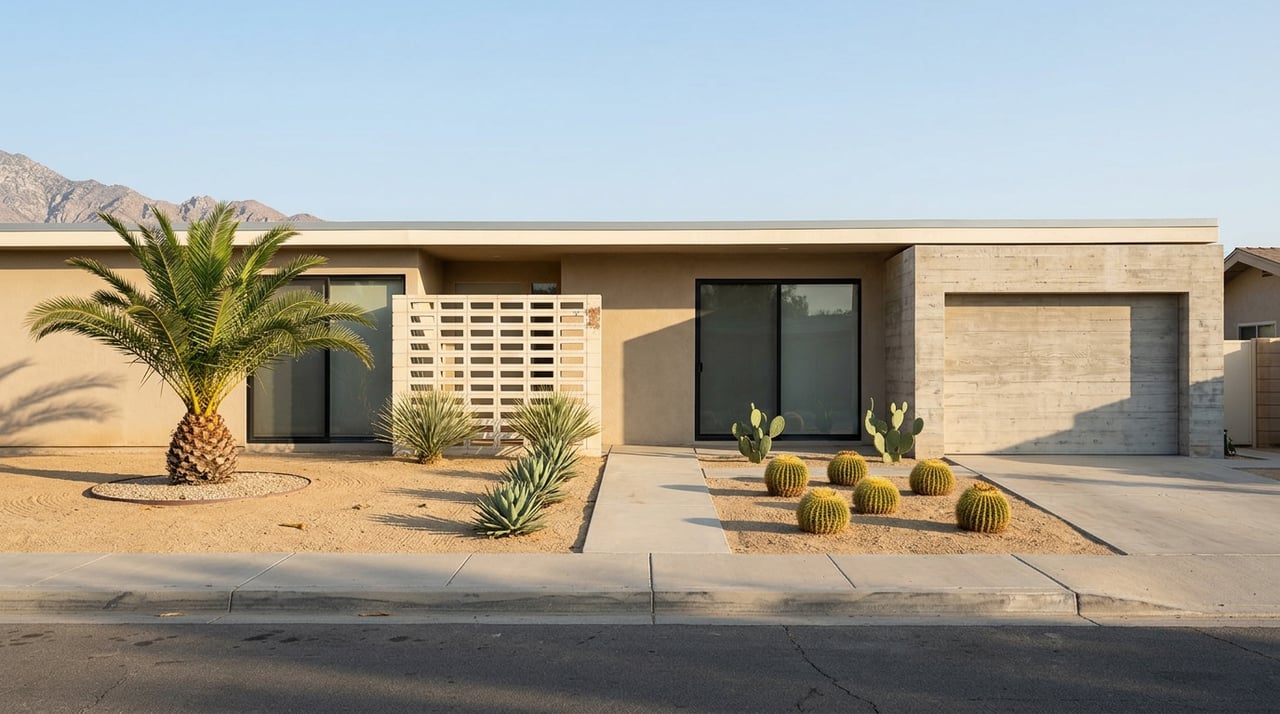
Where Architecture Lovers Buy In Palm Springs
June 4, 2026
June 4, 2026
If Palm Springs is on your radar, you already know this is not a place where architecture is just background. It shapes the streets, the neighborhoods, and often the reason buyers fall in love here in the first place. If you want a home with real design pedigree, this guide will help you understand where architecture lovers tend to buy in Palm Springs and how to narrow your search with more confidence. Let’s dive in.
Palm Springs is best known for Mid-Century Modern design, but the city’s architectural story is much broader. Official historic context identifies styles that include adobe, Spanish Colonial Revival, Mediterranean Revival, Streamline Moderne, Ranch, International Style, mid-century modern, Googie, Brutalism, and late modern.
That variety matters when you start shopping. You are not choosing from one look or one era. You are choosing between neighborhoods with different design identities, different streetscapes, and different relationships to history.
Another important factor is supply. Palm Springs says most of the city is already built out, with new land development typically limited to sensitive hillside sites or infill. In practical terms, that means many of the best architecture-driven buying opportunities are in established neighborhoods rather than large new subdivisions.
Design-focused buyers usually sort Palm Springs homes through four simple filters. Those filters are period authenticity, privacy versus street presence, lot and view quality, and how much alteration you are comfortable with.
A pristine postwar tract home can feel very different from a mixed-style property in an older neighborhood. One may deliver a stronger original design statement, while the other may offer more variety, more landscape maturity, or more flexibility in how the home lives today.
It also helps to know that some older homes are regulated differently. The city notes that historic properties and contributing structures in designated districts may have different rules than ordinary vintage homes, especially when you are planning exterior changes. Before you buy, confirm whether a property is simply older, individually designated, or part of a historic district.
For many buyers, the search begins with the classic tracts that helped define Palm Springs modernism. These neighborhoods are the clearest expression of the city’s postwar design identity.
Twin Palms is one of the most important mid-century neighborhoods in Palm Springs. City materials describe it as the first midcentury neighborhood built by the Alexander Construction Company in Palm Springs, and it is especially known for its butterfly rooflines.
If you want that postcard version of Palm Springs modernism, Twin Palms is often the benchmark. It has strong architectural recognition and a very clear sense of period character.
Vista Las Palmas is another marquee choice for architecture lovers. The city describes it as a midcentury neighborhood where architecture and celebrity make history, with contributions from the Alexander Construction Company, William Krisel, Dan Palmer, and Charles Dubois.
You will find a visually rich mix here, including butterfly-roof homes, Swiss Miss A-frames, and the House of Tomorrow at 1350 Ladera. For buyers who want a neighborhood with strong design pedigree and high name recognition, Vista Las Palmas is a standout.
Racquet Club Estates is a major chapter in Palm Springs residential design. City planning records identify it as the Alexander Construction Company’s largest Palm Springs development, designed by Palmer & Krisel from 1958 to 1961 as mid-century modern post-and-beam housing.
This neighborhood gives you scale as well as identity. If you want tract-era modernism with deep local recognition, Racquet Club Estates is often high on the shortlist.
El Rancho Vista Estates offers a more intimate take on Palm Springs modernism. The city says Donald Wexler and Ric Harrison designed about 70 homes here in 1959 and 1960, and that the tract feels more custom than mass-produced because of alternating elevations, rooflines, and its lower-density layout.
For buyers drawn to Wexler-era design, this can be a compelling fit. It often appeals to people who want architectural credibility without the feel of a larger tract.
If you love architectural variety, deeper history, or classic Palm Springs lore, the older core neighborhoods deserve serious attention. These areas often blend style, story, and established landscape in a way newer homes cannot replicate.
Old Las Palmas is Palm Springs’ oldest neighborhood, dating to the mid-1920s. The city describes an architectural range here that runs from Spanish Colonial to Palm Springs modern.
This is a strong option if you value prestige, mature surroundings, and a neighborhood where no single style dominates. It suits buyers who want architectural range rather than a pure mid-century tract identity.
Movie Colony East carries both celebrity history and architectural significance. The city links the neighborhood to Albert Frey, E. Stewart Williams, Donald Wexler, Frank Sinatra, Bob Hope, Bing Crosby, Howard Hughes, and others.
If you want a neighborhood that blends recognizable Palm Springs history with real design pedigree, Movie Colony East is an easy one to understand. It captures the spirit of the 1950s and 1960s in a way many buyers find hard to resist.
Historic Tennis Club offers one of the oldest and most atmospheric settings in the city. According to the city, the area evolved from early adobe and vernacular beginnings into a mix of Spanish-style homes, historic inns, and the 1925 O’Donnell House overlooking the district.
This neighborhood feels different from the classic tract areas. It is closely tied to the village core and has an older-town atmosphere that appeals to buyers who want history and setting as much as a specific architectural label.
Racquet Club West is another neighborhood worth considering if you like variety. The city describes it as a former Hollywood hangout with villas, cottages, Spanish casas, and homes by Don Wexler and the Alexanders.
That blend gives the area a looser streetscape and a layered identity. It can be a smart fit if you want both social history and a broader architectural mix.
Not every architecture lover wants the most photographed address. Some buyers are drawn to neighborhoods that still offer design interest, but with a more residential rhythm and less emphasis on landmark status.
Deepwell Estates combines mid-century character with architectural variety. The city says the neighborhood includes homes from the mid-20th century through newer green houses, with many properties screened by hedges.
For buyers, the appeal is balance. You get design interest and a lived-in residential feel, which can be especially attractive if you want Palm Springs style without the energy of the most tour-heavy neighborhoods.
Indian Canyons offers a resort-residential atmosphere with strong visual appeal. The city describes it as a neighborhood originally built in the 1960s that now includes both refurbished mid-century modern homes and tile-roofed Southwestern ranches.
Palm-lined streets, mountain views, and a golf-course setting shape the experience here. If you want architecture plus a relaxed desert lifestyle setting, Indian Canyons is often a strong match.
The Mesa stands out for its eclectic architecture and mountain-edge topography. The city says it sits at the base of the San Jacinto Mountains and includes Spanish-style, adobe, mid-century modern, contemporary, California Ranch, and Streamline Moderne homes.
This is not a uniform neighborhood, and that is exactly the point. If you enjoy visual variety and a setting that feels a little more tucked into the landscape, The Mesa deserves a close look.
Some buyers love Palm Springs design language but want newer construction. In that case, the city-guided contemporary pockets become especially relevant.
Desert Palisades is the clearest example of Palm Springs’ newer architectural direction. The city-approved specific plan calls for architecture rooted in desert modernism and regional vernacular, with transparency, natural materials, mountain views, strong indoor-outdoor relationships, and low-slope or shed roofs.
If your goal is a newer home that still feels connected to Palm Springs design culture, Desert Palisades is the key neighborhood to watch. It offers a contemporary interpretation of the city’s architectural legacy rather than a restored vintage one.
In Palm Springs, neighborhood identity is not just marketing language. The city formally recognizes neighborhood organizations and uses blade signs to mark many of the areas most relevant to architecture buyers, including Twin Palms, Vista Las Palmas, Racquet Club Estates, The Mesa, Indian Canyons, Deepwell Estates, Historic Tennis Club, Old Las Palmas, Movie Colony East, and El Rancho Vista Estates.
That matters because the name on the sign often aligns with a real planning, preservation, and community identity. When you are comparing options, those boundaries can help you better understand what a neighborhood represents in the market and on the ground.
If you want to narrow your search quickly, this framework can help.
Palm Springs also continues to present many of these neighborhoods as architecture destinations. Recent city Modernism Week content featured tours in Movie Colony, Old Las Palmas, Vista Las Palmas, Historic Tennis Club, The Mesa, Indian Canyons, and Twin Palms, which reinforces how central these areas remain to the city’s design story.
The best place to buy in Palm Springs depends on what kind of architecture lover you are. You may want original butterfly roofs and post-and-beam lines, or you may prefer layered history, mountain-edge eclecticism, or a newer desert-modern statement.
The key is to match the home to the experience you want every day. When you look beyond style alone and consider neighborhood identity, preservation context, views, privacy, and how the property has changed over time, your search becomes much smarter.
If you want help narrowing the right Palm Springs architecture neighborhood for your goals, connect with Scott James Properties for concierge-level guidance tailored to design-minded buyers and sellers.
Stay up to date on the latest real estate trends.
We pride ourselves in providing personalized solutions that bring our clients closer to their dream properties and enhance their long-term wealth. Contact us today to find out how we can be of assistance to you!